B2B Copywriting Services: What to Buy and How to Judge It
What B2B copywriting services include, how they differ from B2C, how engagements run, what drives cost and how to measure results before you hire.
B2B copywriting services are paid engagements in which a writer or team researches your buyers and produces the words that move them toward a sale: website pages, landing pages, emails, case studies and sales material. The good ones start with your buyer’s problem and end with a measurable action, such as a form fill, a call or a demo request. This guide explains what you should expect to receive, how the work runs, what drives the price and how to tell whether the copy is working.
TL;DR
- B2B copy has to educate a careful, multi-person buying group. Slogans and vague claims do not survive that audience.
- Website copy comes first for most companies, because every other channel sends people to those pages.
- Scope drives cost: page count, research depth, interviews, revisions and technical subject matter.
- Judge copy by actions on the page (inquiries, calls, signups) and not by word count or how it reads to you.
- Copy performs best when it is built together with page design, search visibility and lead capture.
Table of Contents
- What B2B copywriting services include
- How B2B copy differs from B2C copy
- What a good engagement looks like, step by step
- Website pages a B2B copywriter should write
- How copy supports SEO and lead generation
- What affects the price
- Questions to ask before you hire
- How to measure whether the copy works
- Our perspective: copy is one part of a lead system
- How we approach website copy
- FAQ
- Sources
What B2B copywriting services include
A B2B copywriter writes persuasive material for companies that sell to other companies. The deliverables usually fall into a few groups.
- Website copy: home page, service or product pages, about page, industry pages and calls to action. This is what most people mean by a B2B website copywriter.
- Landing pages: single-purpose pages built around one offer and one action, often tied to a search campaign or email.
- Email copy: welcome sequences, nurture emails for leads who are not ready to buy and follow-ups after a quote.
- Proof content: case studies, testimonials written up properly, and one-page summaries a buyer can forward to a colleague.
- Educational content: articles, guides and comparison pages that answer the questions buyers ask before they ever contact you.
- Sales support: brochures, proposal language and leave-behind sheets.
It helps to separate two jobs that often get blurred. Copywriting asks the reader to act. Content writing educates the reader and builds trust over time. Most B2B companies need both, but they are bought and briefed differently. If your site gets visits and no inquiries, the problem is usually the first job.
How B2B copy differs from B2C copy
The difference is the audience and the buying process, not the quality of the writing. Semrush’s B2B writing guide describes B2B writing as helping business audiences understand and solve challenges, while B2C writing leans more on casual, conversational and emotional appeals.
Bob Bly, a long-time direct-response copywriter, makes the same point from the practitioner side. In his comparison of B2B and B2C marketing, he notes that B2B buyers are typically sophisticated, business products tend to be more complex, and purchases often involve a multistep process rather than one decisive piece of copy. Shopify’s comparison adds that B2B content is aimed at owners, executives, buyers and department heads, and leans on expertise, business goals, case studies, white papers and ROI tools.
In practice, that changes how you write:
- Several readers, one page. An owner cares about risk and cost. An operations manager cares about whether it fits current work. A finance contact wants the numbers. Good copy answers all three without becoming long-winded.
- Specifics over adjectives. “Fast turnaround” means little. “Quotes within one business day” can be checked.
- Proof near every claim. Results, named processes, certifications and customer outcomes sit next to the promise they support.
- A next step for every stage. Some visitors are ready to call. Others want a checklist or a short email series first. The page offers both.
What a good engagement looks like, step by step
Expect the process below. If a provider skips the first two steps and sends you a quote and a draft, you will likely get generic copy.
1. Discovery and research
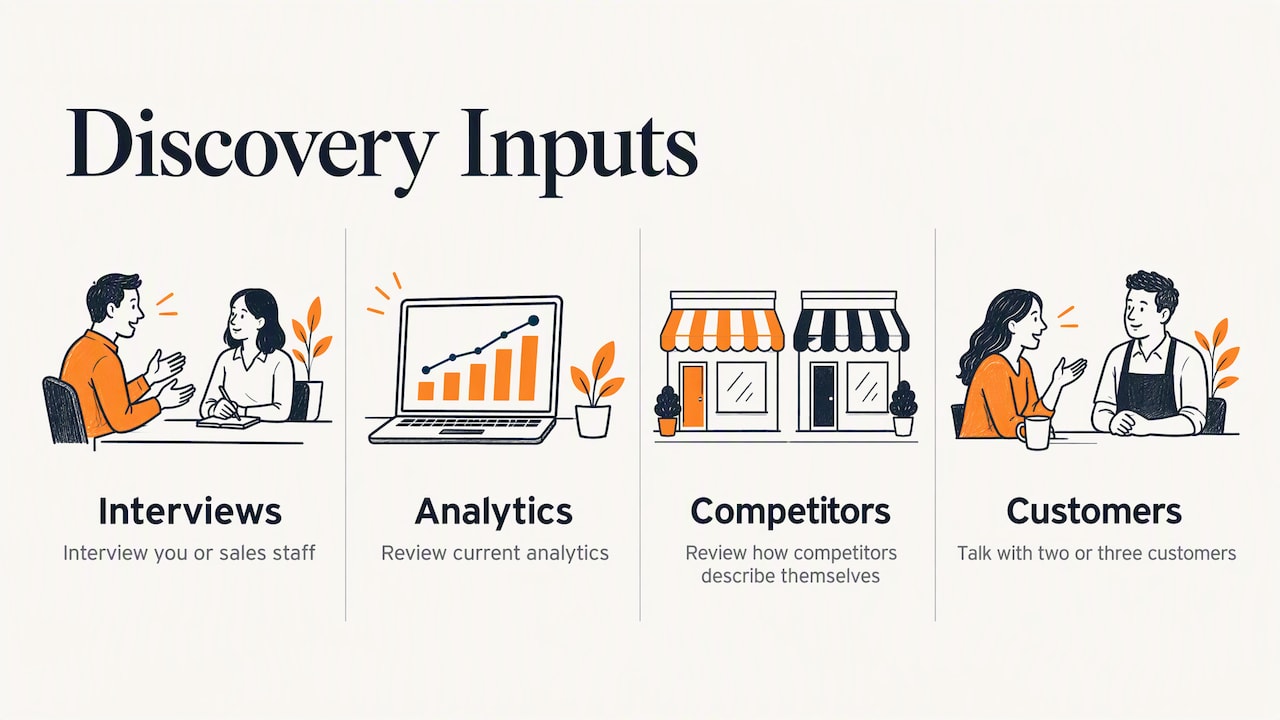
The writer needs your customers, not just your brand guide. That means interviews with you or your sales staff, a look at your current analytics, a review of how competitors describe themselves and, ideally, a conversation with two or three customers. The Content Marketing Institute’s Eaton case study shows the same buyer-first logic at enterprise scale: validate customer problems through research and interviews, map questions to stages of the journey and tailor content to the different roles in a long buying cycle.

2. Brief and message hierarchy
Before full drafting, you should see a short brief: who the page is for, the one action it asks for, the three or four points that earn that action and the proof for each. Approving this takes minutes and prevents rewrites.
3. Draft
The first draft is written to the brief, with headlines, subheads, body copy, button text and form wording. Page copy and layout should be considered together, because a headline that works in a wide hero area may not fit a narrow mobile screen.
4. Revisions
Ask how many revision rounds are included and what counts as a revision. Fixing a factual error is different from changing the offer. Put the difference in writing.
5. Launch, measure, adjust
Copy is a hypothesis until real visitors read it. A sound engagement ends with tracking in place and a plan to revisit the pages after enough traffic has arrived to see a pattern.
Website pages a B2B copywriter should write
If you are hiring primarily for your website, here is what to expect page by page.
| Page | Job it does | What the copy should contain |
|---|---|---|
| Home page | Tells the right visitor they are in the right place | A clear statement of who you serve and what you do, proof, one primary action |
| Service or product pages | Moves a researching buyer toward contact | The problem, your approach, what is included, results, objections answered |
| Industry or location pages | Matches specific searches | The language of that sector or area, relevant examples |
| About page | Reduces perceived risk | Who is behind the company, how long you have worked, how you operate |
| Case studies | Proves it worked | Situation, action, outcome, in the customer’s terms |
| Contact and landing pages | Converts | A short form, what happens next, response time |
A useful rule: every page has exactly one main action. When a page asks for a call, a download, a newsletter signup and a social follow all at once, it usually gets none of them.
Blog posts follow a different workflow. Search Engine Land’s guide to writing a blog post recommends validating the topic, matching the template to search intent, writing the headline carefully, opening with something useful and optimizing on-page elements before promoting the piece. Treat articles as support for your service pages and not a substitute for them.
How copy supports SEO and lead generation
Search visibility and conversion are not competing goals. Google’s SEO Starter Guide says that easy-to-read, well-organized, helpful, reliable and up-to-date content that anticipates the terms people search for can help a site’s presence in search results. That is a description of good B2B copy too.
Three practical consequences:
- Write for the phrase your buyer types. Use the plain words a purchasing manager would search, then support them with the technical terms your specialists use.
- Structure the page for scanning. Descriptive headings, short paragraphs and lists help both readers and search engines understand what a page covers.
- Connect each page to the next step. Internal links to related services, and a clear call to action, turn a visit into a lead. Our own pieces on generating more leads through your website and conversion features that increase sales cover the on-page mechanics in more detail.
If your buyers are local or regional, such as contractors, distributors and service companies selling to other businesses nearby, add location-specific pages and a consistent business profile. That is where local SEO and copy work together.
What affects the price
Published B2B copywriting rates vary widely, and a single average would mislead you. AWAI’s 2025 pricing report says its fee ranges were compiled from research into common copywriting projects, industry leaders, national resources and marketers, and it stresses that scope and project type should guide pricing. Use that as your own guide when comparing quotes. These are the factors that move a quote up or down:
- Number and type of pages. A 12-page site costs more than a 5-page site, and a long sales page costs more than a short contact page.
- Research depth. Customer interviews and competitor review take time but are what separate specific copy from generic copy.
- Technical complexity. Industrial, software and financial subjects need more learning and more subject-matter review.
- Revision rounds and stakeholders. Every additional approver adds time.
- SEO requirements. Keyword research, headings and metadata add scope.
- Ongoing versus one-off. Monthly arrangements usually cost less per piece than one-off projects but commit you for longer.
When you compare quotes, ask each provider to list what is included. Two quotes with the same total can cover very different amounts of research and revision.
Questions to ask before you hire
- Who will write my copy, and have they written for buyers like mine?
- What research do you do before drafting, and do I get to approve a brief?
- How many revision rounds are included?
- Who owns the copy when the project is complete?
- How will we know if it worked, and what will be tracked from day one?
- Does the copy come with the page design, or will my team have to fit one to the other?
Be cautious of promises about rankings or specific conversion lifts. Nobody can guarantee them before seeing your market, traffic and offer.
How to measure whether the copy works
Most B2B companies do not measure content well. The Content Marketing Institute and MarketingProfs’ 2015 North America research found that only 21% of surveyed B2B marketers said they were successful at tracking content-marketing ROI, rising to 35% among organizations with a documented strategy. The data is old and specific to North America, but the lesson holds: write down what you want before the copy is written.
A simple measurement plan:
- Pick one primary action per page: form submission, click-to-call, quote request or demo booking.
- Track it separately for each page, with analytics goals and consistent campaign tags on your links.
- Compare before and after over a period long enough to include a normal sales cycle for your business.
- Read the leads. The questions prospects ask in their first message tell you what the copy failed to explain.
- Follow leads to revenue, not only to the form. A page that brings fewer but better inquiries may be doing its job.
Our perspective: copy is one part of a lead system
We build websites for businesses that need them to produce inquiries, and we see the same pattern often. A company pays for new design, keeps its old, vague wording and wonders why nothing changes. Or it pays for sharp copy and drops it into a slow, cluttered page with no obvious next step. Neither works.

So we treat the words, the layout, the search setup and the follow-up as one system. Persuasive copywriting and data-driven design are part of our website work, alongside local SEO and automated follow-up for new leads. The goal is a site that earns qualified inquiries without depending on constant ad spend.
Our advice if you are choosing a provider: do not buy copy as a standalone item unless your site structure and tracking are already sound. Check the page first. If visitors cannot find the next step in a few seconds, better sentences will not solve it. Fix the structure, then write to it, then measure. It is slower than ordering a batch of pages, but it is how a website becomes an asset your sales team relies on.
— Rafael
How we approach website copy
Our website packages put copy, design and lead capture in one project. They are listed at $197 per month for Starter, $397 per month for Momentum and $447 per month for Accelerate. A setup fee applies, and its amount is not published, so ask for it when you inquire. If you want to see everything we offer, including local SEO, email automation and design work, the services page lays it out. If you have a site that gets traffic but few inquiries, start with our piece on making your website your personal salesman.
FAQ
What does a B2B copywriter do?
A B2B copywriter researches a company’s buyers and writes persuasive material that moves them toward a purchase decision. That includes website pages, landing pages, emails and case studies. The work is usually more technical and more proof-heavy than consumer copy, because several people often take part in the decision.
How is B2B copywriting different from content writing?
Copywriting asks the reader to take an action, such as requesting a quote. Content writing educates, such as an article that answers a buyer’s question. Most B2B companies need both. Service pages and landing pages are copywriting work, and blog posts and guides are content work.
How much do B2B copywriting services cost?
It depends on scope: page count, research, technical subject matter, revisions and SEO requirements. Rates differ widely by provider, so compare itemized quotes and not totals. Ask what research and revision rounds each quote includes.
Do I need a B2B website copywriter or a full website redesign?
If your site structure, speed and calls to action already work, new copy alone may help. If visitors struggle to find the next step or the site is outdated, copy and design should be fixed together. A quick review of your analytics and your key pages will show which applies.
Sources
- B2B Writing Guide, Semrush
- 6 Key Differences Between Business-to-Business and Business-to-Consumer Marketing, AWAI
- B2B vs. B2C Content Marketing, Shopify
- Buyer-First Content Engine for Machine Builders, Content Marketing Institute
- How to write a blog post, Search Engine Land
- SEO Starter Guide, Google Search Central
- State of the Industry Report 2025, AWAI
- B2B Content Marketing research 2015, Content Marketing Institute and MarketingProfs
Recommended
Share this article

Written by : Rafael
Follow us
A quick overview of the topics covered in this article.
Latest articles
November 8, 2026
November 8, 2026