Local SEO Leads: How to Turn Searches Into Calls
Local SEO leads come from more than rankings. Learn the profile, page, review, follow-up and tracking steps that turn nearby searches into calls and booked jobs.
Local SEO produces leads when three things work together: people find your business in local results, your listing and website give them reason to trust you, and a fast, easy path leads them to call, book or submit a form. Rankings alone do not pay anyone. This guide walks through each step in order, with the metrics that show whether it is working.
The approach applies to any business that serves a defined area, from trades to clinics to law and accounting firms. For one example of how a trade tackles it, see this walkthrough of SEO for electricians, which shows the same logic at work.
TL;DR
- Local SEO earns leads by matching what nearby customers search for with a complete profile, focused service pages and visible proof.
- Google weighs relevance, distance and prominence. You control relevance and prominence, so start there.
- A top map ranking with a weak page or slow follow-up still produces nothing. Fix the path from click to call.
- Measure calls, form submissions and bookings, not just positions.
- Automate the first response so no lead waits hours for an answer.
Table of Contents
- What a local SEO lead actually is
- Step 1: Build a profile that earns the click and the call
- Step 2: Match your pages to what local customers search
- Step 3: Make reviews a steady habit
- Step 4: Turn the visit into a contact
- Step 5: Automate the first response
- Step 6: Measure leads, not just rankings
- Perspective: why we build for the lead, not the rank
- Where Origin Assets fits
- A realistic first 30 days
- Common mistakes that cost leads
- FAQ
- Sources
What a local SEO lead actually is
A lead is a real person who raises a hand: a phone call, a form, a chat message, a direction request that turns into a visit. Traffic and rankings are inputs. Leads are the output.
The distinction matters because many owners judge a campaign by position. Google describes local ranking as a mix of relevance (how well your profile matches the search), distance (how far you are from the searcher) and prominence (how well known you are, including reviews and links). Position is the result of those factors. It tells you nothing about whether the visitor who found you picked up the phone.
A useful way to organize the work comes from a 90-day local SEO plan for service businesses: relevance (clear services and service area), prominence (reputation and trust signals) and conversion (a website and profile built to get contacted). The author’s point is that visibility stays unstable when only one of the three is handled. A business with great reviews and a confusing website loses leads. A business with a polished site and no reputation never shows up.
The rest of this article follows that order.
Step 1: Build a profile that earns the click and the call
Your Google Business Profile is the public source of truth about your business. For many local searches it appears before any website result, and for many customers it is the only thing they read before calling.
A university extension guide for small businesses notes that map results depend on relevance to the search, regular activity and geographic precision. It also observes that busy owners tend to do the bare minimum, which is exactly the gap a complete, active profile can exploit.
Work through this list:
- Claim and verify the profile under the exact name customers know you by.
- Choose the right primary category. It is the strongest signal of what you are relevant for. Add secondary categories only for services you actually sell.
- List every service you offer, with plain descriptions in the words customers use.
- Set your service area honestly. Name the cities and neighborhoods you actually serve and reach.
- Keep hours and holiday hours current. A listing that shows closed when you are open sends the call elsewhere.
- Add real photos of your work, your team and your vehicles or storefront.
- Post updates regularly, such as completed projects, offers and seasonal reminders.
- Turn on messaging and add a booking link if you can answer quickly.
We keep a longer version of this checklist in our Google Business Profile optimization guide, including what to check each month.
Keep your name, address and phone number identical everywhere
Consistent business details across your profile, your website and local directories reduce confusion and strengthen trust signals, according to the same 90-day plan. In practice: pick one spelling of your business name, one format for suite numbers, one primary phone number, and use them everywhere. Audit the major directories and data aggregators once, fix the mismatches, and then recheck every quarter.
Step 2: Match your pages to what local customers search
Local keyword research is less about volume and more about situation. Someone typing “AC repair near me” on a hot afternoon is in a different place from someone comparing installation quotes in spring.
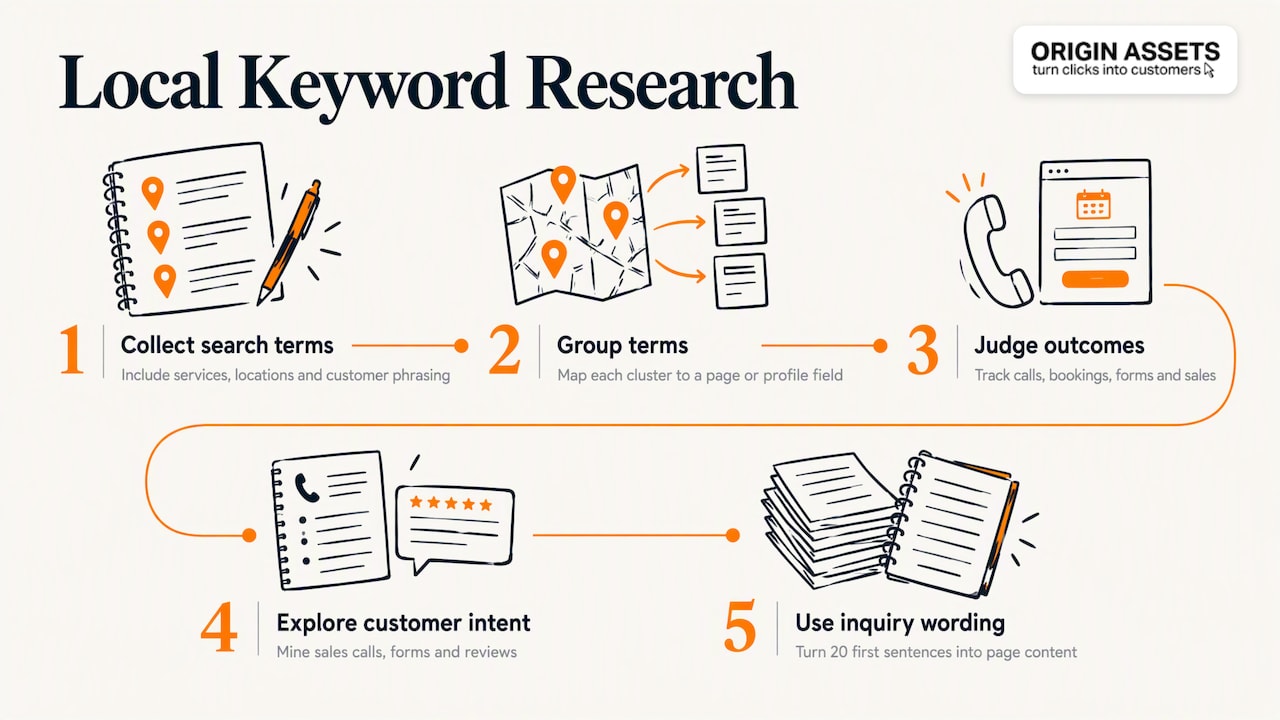
A step-by-step local keyword research guide recommends collecting service and location terms, including neighborhood-level searches, customer phrasing and urgency modifiers such as “emergency” or “same day.” Then map each cluster to a specific page or profile field, and judge the keywords by calls, bookings, forms and sales rather than by traffic.
Go one level deeper than keywords. Search Engine Land’s piece on mapping local search intent says to identify the customer’s situation, constraints, decision criteria, geography, timing and stage in the decision. It also recommends mining sales calls, intake forms and reviews for the customers’ own wording, because those sources expose the questions people ask right before they buy.
A simple exercise: read your last 20 inquiries and write down the first sentence each person used. Those sentences are your headings, your FAQ questions and your page openers.

One page per service and location
A generic “Our Services” page rarely matches a specific search. Backlinko’s local keyword guide recommends a dedicated page for each important service and location combination, for example separate pages for AC repair, maintenance and installation in the same city, so each page answers one search directly.
If you serve towns beyond your office, dedicated pages for genuine nearby service areas can capture searches such as “AC repair in Boulder.” The key is real substance. BrightLocal’s service area page guide says useful pages include genuinely local details, such as building codes, weather patterns and reviews from the community, which helps visitors recognize local expertise and can improve conversion. Swapping the city name on a copied page does the opposite.
A strong service-area page includes:
- A headline naming the service and the place
- Two or three paragraphs on problems specific to that area
- Photos or short summaries of recent jobs nearby
- Reviews from customers in that area
- A phone number and a short form above the fold
- Three to five FAQs with direct answers
Our local SEO tips page covers more on structuring these pages, and our article on what local SEO investment returns explains why they compound over time.
Step 3: Make reviews a steady habit
Reviews do two jobs. They support prominence in rankings, and they persuade the person already on your profile. A BrightLocal survey found that 88% of consumers trust online reviews as much as personal recommendations. Note that the survey dates from 2015, so treat the exact figure as a directional signal rather than a current benchmark.
Two practical points from Search Engine Land’s Google Business Profile guide: the local SEO industry has long observed a lift once a listing reaches its first 10 reviews, but the real goal is to steadily earn and eventually exceed the review counts of the competitors in your results. The guide quotes Miriam Ellis describing review collection as a marathon, not a sprint.
A workable review routine:
- Ask at the moment of satisfaction: right after a completed job or a positive comment.
- Send a direct link by text or email. Fewer taps means more reviews.
- Make it a standing step in your job-complete checklist, owned by one person.
- Reply to every review, positive or negative, within a couple of days.
That last step matters more than most owners expect. The extension guide cited above notes that most consumers will give a business a second chance if it responds professionally to a negative review. See our guide to earning more Google reviews for scripts and timing.
Step 4: Turn the visit into a contact
This is where most local SEO campaigns quietly fail. A business can hold the top map positions and still generate little, because the landing page is slow to explain, hard to use on a phone, or buries the contact method.
The 90-day plan referenced earlier gives the baseline: service pages should make it easy to call, submit a form or book, and include local proof, FAQs and contact paths that work on mobile. Check each service page against this list:
- A tap-to-call number visible without scrolling on a phone
- A short form asking only for name, contact method and what the person needs
- A clear statement of what happens next, such as “we reply within one business hour”
- Local proof: nearby reviews, project photos, licenses and insurance where relevant
- Plain pricing guidance where you can give it, or a description of how quoting works
- Fast loading and readable text on a mid-range phone
If your site is the bottleneck, redesigning it is often the highest-return fix. We build sites around this exact path, which is why website design sits at the center of our offer.
Step 5: Automate the first response
A lead that waits is a lead that calls the next result. People searching locally are often comparing two or three businesses at once, and the first to reply usually frames the rest of the conversation.
A workable automated sequence, adapted from a nurture sequence framework for organic and paid leads, looks like this:
- Tag every form, call and chat with its source so you know where the lead came from.
- Send an immediate text or chat reply confirming you received the request.
- Ask two or three qualifying questions about what the person needs and how urgent it is.
- Offer available booking slots to warm leads.
- Follow up by text or email if there is no response.
- Route urgent requests, custom pricing questions and booking-ready leads to a person right away.
Automation should handle speed and routine, not replace judgment. Anything urgent or unusual belongs with a human. Our email marketing automated systems service sets up this kind of follow-up so leads from search do not go cold.
Step 6: Measure leads, not just rankings
BrightLocal’s survey of SEOs found 48% named phone calls as the most important KPI, ahead of search ranking at 46%. Again, it is an older study, but the lesson holds: even people who sell rankings for a living put calls first.
A complete view combines three layers, as a guide to measuring local Google performance lays out:
| What you track | Where to find it | What it tells you |
|---|---|---|
| Calls, direction requests, website clicks, messages | Google Business Profile performance | Whether the listing prompts action |
| Sessions and conversions | Analytics | Whether site visitors take the next step |
| Impressions, clicks, CTR, average position | Search Console | Whether you are visible for the right searches |
Add one more column your tools will not give you: the sale. Ask every new customer how they found you, and record it. Over a few months you will see which pages and keywords create revenue, and which only create traffic.
Perspective: why we build for the lead, not the rank
We have worked with local businesses for a decade, and the pattern repeats. Owners come to us after paying for SEO and seeing rankings improve while the phone stays quiet. The cause is almost never the ranking.
It is usually one of three things: a website that looks fine but gives no clear next step, a profile that says less than the competitor’s, or follow-up that takes a day instead of minutes. Each one is fixable, and none requires more ad spend. A visitor you already earned is worth more than a visitor you have to buy.
That is why we treat local SEO, design, copy and automation as one system. Visibility brings people in, the page persuades them, and the follow-up catches them before they leave. If one link is weak, the others cannot compensate.
Our advice to any owner: before you invest in more visibility, call your own business the way a customer would. Search for your service, tap your listing, fill in your form, and time the reply. What you find will tell you where the money is leaking.
— Rafael
Where Origin Assets fits
If you would rather have this built than manage it yourself, our local SEO service covers the visibility side, and our website packages cover the conversion side. Packages are priced monthly: Starter at $197 per month, Momentum at $397 per month and Accelerate at $447 per month. A setup fee also applies, and the details are on the pricing page.

We also keep the site maintained after launch through website management and maintenance, so the pages that bring in leads stay fast, accurate and secure.
A realistic first 30 days
You do not need to do everything at once. Here is a sequence that fits a small team:
Week 1: Audit. Search your main service in your city on a phone. Note who appears, how complete their profiles are and how many reviews they have. Test your own form and phone number. Record the baseline: calls and forms per week.
Week 2: Fix the profile and listings. Complete every field, choose accurate categories, add photos and align your name, address and phone across directories.
Week 3: Fix the page that matters most. Pick the service that earns the most profit, and rebuild its page around one search. Add the call button, form, local proof and FAQs.
Week 4: Add the habits. Set up the review request, the automated first reply and a monthly report that lists calls, forms and bookings by source.

If you serve a seasonal trade, this timing helps you get ready before demand rises. Our HVAC marketing page shows how that looks in a high-urgency trade, and our piece on winning local leads as search changes covers what AI-generated results mean for small businesses.
Common mistakes that cost leads
- Chasing position over action. Reporting on rankings alone hides the real problem.
- Copying one page across many cities. Thin, near-identical pages add little for visitors.
- Listing services you do not offer to appear in more searches. It brings the wrong calls and hurts reviews.
- Ignoring negative reviews. A professional reply protects the lead you would otherwise lose.
- Slow follow-up. If the reply takes a day, assume the lead is gone.
- No source tracking. Without it, you cannot tell which effort created revenue.
FAQ
How long does local SEO take to produce leads?
It depends on your market, your starting point and how complete your profile and site are. Profile fixes and conversion changes to your pages can improve results sooner than rankings do, because they work on visitors you already get. Rankings and reputation build gradually, so plan on a steady effort over months rather than weeks.
What is the difference between local SEO and lead generation?
Local SEO improves your visibility in local results so you capture people already searching. Lead generation is the wider job of acquiring and converting prospects, which can include outreach, ads and follow-up. The strongest setups combine them: SEO brings discovery, and a clear page plus fast follow-up convert it.
Do I need a website if I have a Google Business Profile?
Yes, in most cases. The profile gets you seen, but your site is where you explain your services in depth, show local proof and capture inquiries with forms and booking. It also gives you pages that can match specific service and location searches.
Which metric should I watch first?
Start with calls, form submissions and bookings. Rankings and impressions are useful diagnostics, but business outcomes tell you whether the work is paying off. Track them by source so you can see what drives them.
Do I have to spend on ads to get local leads?
Not necessarily. A complete profile, focused service pages, steady reviews and fast follow-up can generate leads from organic local search. Ads can add volume, but they work best on top of a site that already converts.
Sources
- Tips to improve your local ranking on Google
- Local SEO sprints: a 90-day plan for service businesses
- How to raise your Google Business Profile to attract more customers
- Local SEO keyword research: a step-by-step guide
- 6 steps to map local search intent beyond keyword data
- Local SEO keyword research: 5 steps
- How to do service area page SEO
- Phone calls and search ranking are the most important local search KPIs
- How to set up and optimize your Google Business Profile
- Designing an evergreen AI-first nurture sequence
- Local SEO on Google in 2026: measure, track and improve
- SEO for electricians: easy strategies for more leads
Recommended
Share this article

Written by : Rafael
Follow us
A quick overview of the topics covered in this article.
Latest articles
November 8, 2026
November 8, 2026